4Health Dog Food: How It Compares on the Label
General nutrition information compiled from product labels and published sources, not veterinary advice. Your veterinarian is the right person to choose a diet for your dog, especially one with a health condition.
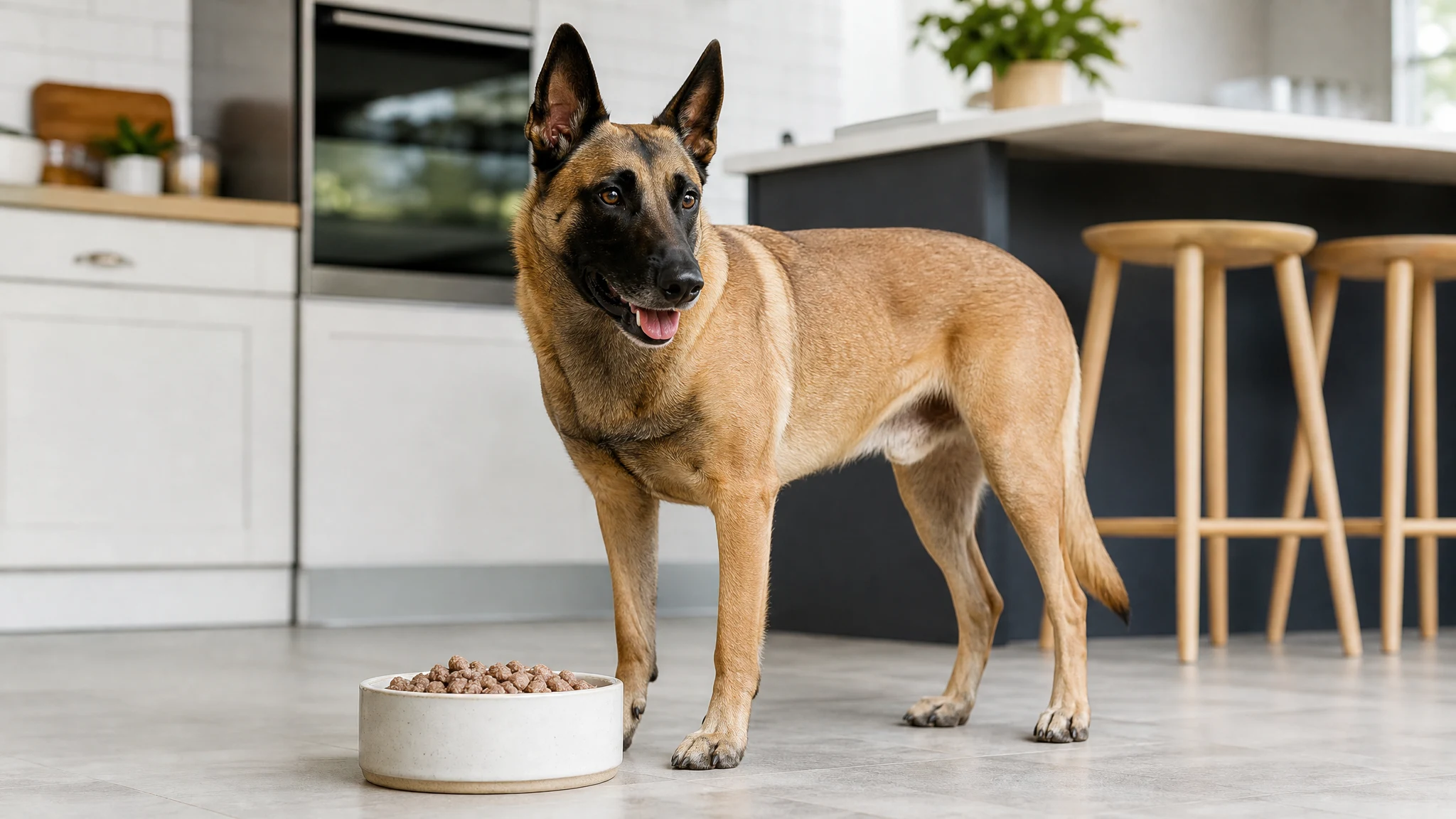
If you are weighing 4 health dog food for a Belgian Malinois, the bag itself is the best place to start. The label shows who the food is built for, what it is made of and how many calories it carries.
This guide shows you how to read a 4Health label and set it beside other foods. It does not quote 4Health numbers, because those belong to the brand. Copy them from your bag or from the brand's own product page, then check them against the steps below.
A note on method: we compared label data only. We did not run feeding trials or taste tests, and nothing here says one food is better for your dog.
Why the label matters for a Malinois
The Hill's Pet breed page lists the Belgian Malinois at 40 to 80 pounds, with males usually heavier than females. It gives a life expectancy of 12 to 15 years. Hill's also advises large-breed puppy food for the breed, so "large" is a fair working size category.
Not every adult Malinois reaches 70 pounds, so do not assume a 70 lb label wording describes your dog. Your veterinarian can tell you where your dog sits.
Materials you will need
- The bag or can of 4Health food you are considering, or its product page on the brand's own site.
- The bag or product page of one or two other foods you want to compare.
- Your dog's age, current weight and body condition, ideally from a recent vet visit.
- A pen and paper, or a simple spreadsheet.
- A kitchen scale and measuring cup, for checking portions later.
Step-by-step: comparing the label
Step 1: Find the AAFCO statement
Look for a sentence that starts with "formulated to meet" or "animal feeding tests using AAFCO procedures substantiate." This is the nutritional adequacy statement. It tells you the life stage the food is meant for: growth, maintenance, or all life stages.
Write down the exact wording. If you cannot find one, check with the brand before buying. A food without it may not be complete and balanced.
Step 2: Check the large-breed growth wording (puppies only)
Whole Dog Journal explains that growth and all-life-stages foods must say either "including growth of large size dogs (70 lb or more as an adult)" or "except for growth of large size dogs." The same article notes that too much calcium can cause bone and joint problems in large-breed puppies.
For a Malinois puppy, the "except for" wording is a red flag. Cornell's Riney Canine Health Center also advises feeding a large-breed diet to growing large dogs and not adding calcium or vitamin D supplements to a puppy's food.
Step 3: Match the life stage to your dog
Royal Canin's general large and giant breed guidance says these dogs mature between 15 months and two years. Hill's labels its large breed puppy food for puppies up to 18 months. Ask your veterinarian when to switch your own dog, and do it gradually.
Step 4: Read the first five ingredients
Ingredients are listed by weight before cooking. The first five give a rough picture of the recipe. Note whether the first ingredient is a named meat, a meat meal or a grain, and whether by-products appear.
Do not treat this as a quality score. A named meat first can still include a lot of water weight, and a meal can be a concentrated protein source. Use the list to notice differences, not to rank foods.
Step 5: Compare protein, fat and fiber on the same basis
This is where people slip. Most bags show guaranteed analysis "as fed," with minimum protein and fat and maximum fiber. Some brand pages, including Hill's, show dry matter averages instead. Those numbers are not the same thing, and they are not minimums.
Only compare numbers that use the same basis. If one food is listed as fed and another on a dry matter basis, ask the brand for the matching figure.
Step 6: Compare calories per cup
Calories decide how much you feed, so this figure matters as much as protein. Look for kcal per cup or per kilogram. Canned foods often list kcal per can instead, so convert with care or ask the brand.
Step 7: Record everything in one table
Put each food in a row. Below are label figures for several large-breed options, so you can see how your 4Health numbers line up. Figures are from each brand's own page.
| Food | AAFCO life stage | Protein | Fat | Calories |
|---|---|---|---|---|
| Royal Canin Large Puppy (dry) | Growth, including large size dogs | 28% min | 14% min | 349 kcal ME per cup |
| Royal Canin Large Adult (dry) | Maintenance | 24% min | 15% min | 360 kcal ME per cup |
| Royal Canin Large Aging 8+ (dry) | Maintenance | 25% min | 15% min | 308 kcal ME per cup |
| Hill's Science Diet Puppy Large Breed Chicken & Brown Rice | Growth (feeding tests) | 26.7% dry matter average | 15.4% dry matter average | 387 kcal per cup |
| Hill's Science Diet Adult Large Breed Chicken & Barley | Maintenance (feeding tests) | 23.8% dry matter average | 15% dry matter average | 365 kcal per cup |
| Victor Hi-Pro Plus Large Breed Puppy | All life stages, including large size dogs | 30% min | 14% min | 365 kcal per cup |
Notice that the Hill's rows use dry matter averages while the others use minimums, so the protein and fat columns are not a clean side-by-side. That is the exact trap described in Step 5.
Orijen Original and Freshpet Vital Chicken are also labeled for all life stages including large size dogs. Their label figures differ widely, partly because Freshpet is a refrigerated fresh food with high moisture. Check the brands' own pages for the full panels.
Step 8: Use the feeding guide as a starting point
Every label gives a feeding chart. Treat it as a starting point, not a rule. Hill's says to adjust amounts to maintain optimal weight and to ask your veterinarian if you are unsure. Royal Canin's pages offer a calculator for a tailored amount.
Weigh out portions for the first few weeks and watch your dog's body condition. Adjust with your vet's guidance.
Step 9: Weigh your dog's specific risks
The Hill's breed page says hip and elbow dysplasia can be common in the breed and that risk can rise with weight gain. It also says excess weight strains the joints and suggests keeping treats to 10 percent of daily calories. It notes the breed can be at risk for allergies with skin or stomach signs.
No food label can promise to prevent or treat any of these. Whether a diet suits an individual dog is a question for your veterinarian.
Step 10: Check how the food will be served
Cornell says large, deep-chested dogs are most at risk of bloat (GDV). It suggests two or more meals a day, smaller kibble, limited activity after meals and no raised bowls. Cornell's page does not name the Malinois, so the breed-specific risk is not confirmed. Ask your vet whether a kibble size or meal schedule makes sense for your dog.
Tips and common mistakes
- Comparing different bases. Do not set an as-fed number next to a dry matter number.
- Judging by the first ingredient alone. It is one clue among several.
- Skipping the life stage. An adult maintenance food is not a growth food, and a puppy needs a large-breed growth statement.
- Supplementing a puppy on your own. Cornell advises against added calcium or vitamin D for growing puppies.
- Ignoring calories. Two foods with similar protein can differ a lot in kcal per cup.
- Switching suddenly. Change foods gradually and tell your vet about any stomach upset.
- Chasing the DCM headlines. The FDA's investigation page was last updated on December 23, 2022, and says it does not plan more public updates until there is meaningful new scientific information. If it worries you, ask your vet.
- Forgetting treats. They count toward daily calories.
Expected results
After you finish the table, you should be able to see which foods match your dog's life stage and size. You may also see how calorie density changes cup amounts. This can make a conversation with your vet more specific.
It will not tell you which food your Malinois will thrive on. Coat, energy, stool quality and weight over time may help show how your dog is doing, but results vary by dog.
For a wider look at large-breed options, see our label comparison of dog foods for Belgian Malinois.
Sources
- Hill's Pet, Belgian Malinois breed page
- American Belgian Malinois Club, Official Standard
- Cornell University Riney Canine Health Center, canine hip dysplasia
- Cornell University Riney Canine Health Center, GDV or bloat
- Whole Dog Journal, In the Fine Print: Nutritional Adequacy Statements
- FDA Center for Veterinary Medicine, DCM investigation
- Royal Canin Large Puppy
- Royal Canin Large Adult
- Hill's Science Diet Puppy Large Breed
- Hill's Science Diet Adult Large Breed
- Victor Hi-Pro Plus Large Breed Puppy