Wet vs Dry vs Fresh Food for Belgian Malinois
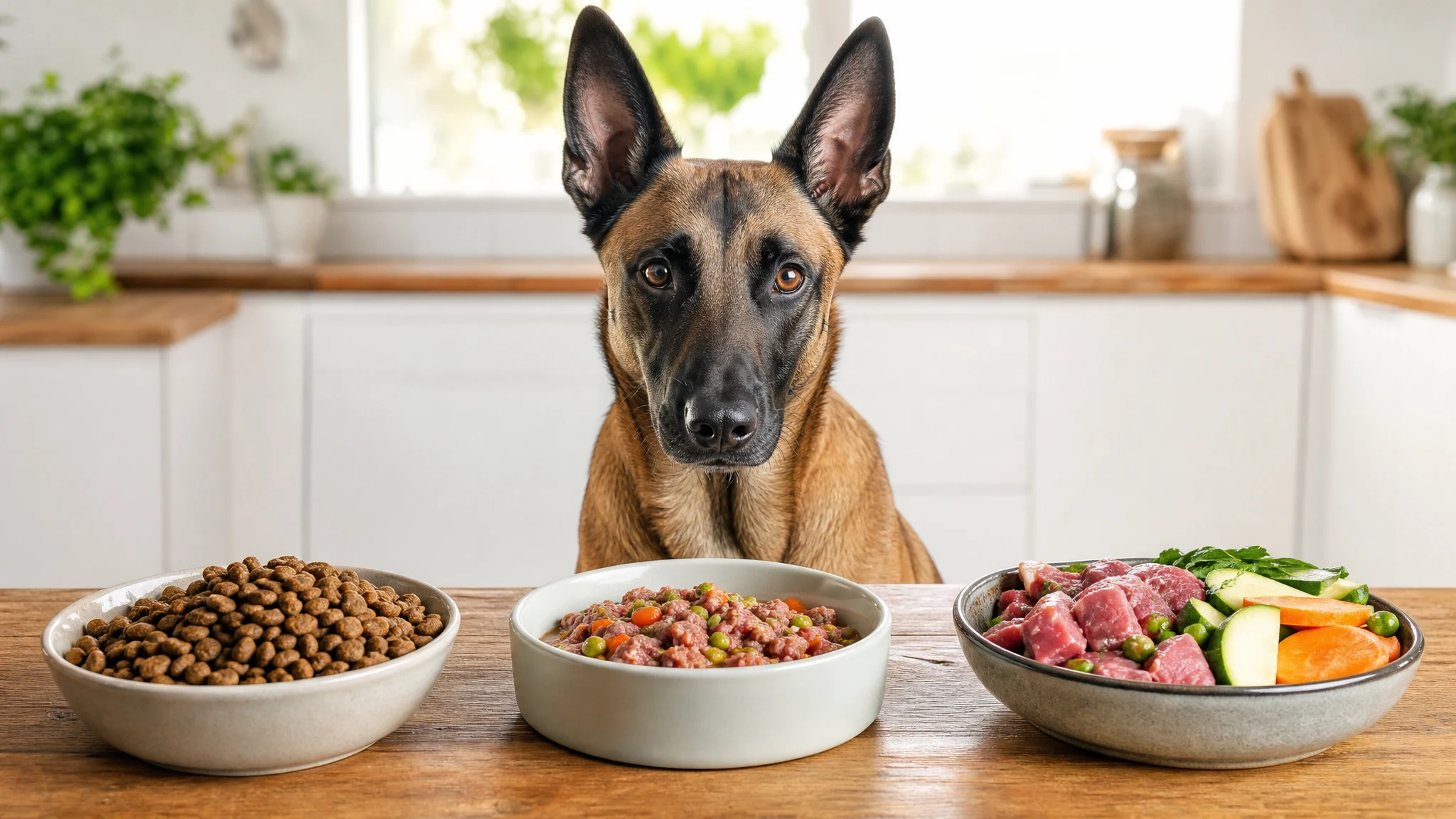
General nutrition information compiled from product labels and published sources, not veterinary advice. Your veterinarian is the right person to choose a diet for your dog, especially one with a health condition.
Walk into any pet food aisle and the forms are lined up like rival teams: kibble, cans, and refrigerated rolls. Each one comes with confident claims. Few of those claims are about your dog.
The Belgian Malinois is a lean, athletic working breed. Hill's Pet lists adults at 40 to 80 pounds, with males usually heavier than females, and a life expectancy of 12 to 15 years. The American Belgian Malinois Club standard gives heights of 24 to 26 inches for males and 22 to 24 inches for females. That is a large dog by any practical measure, so portion size, calorie density and storage all matter more than they would for a small breed.
This page compares wet vs dry dog food and fresh options using what the labels and brand pages say. It ends with a plain verdict.
How this comparison was done
We compared label data: AAFCO statements, ingredient lists, calories and the brand's own feeding notes. We did not run feeding trials or taste tests, and we did not feed any of these foods to dogs. Nothing here says one product is better for your dog.
The examples come from the products we had label data for. The dry foods are Royal Canin Large Puppy, Large Adult and Large Aging 8+, Hill's Science Diet Puppy Large Breed and Adult Large Breed, Victor Hi-Pro Plus Large Breed Puppy and ORIJEN Original. The wet example is Hill's Science Diet Adult Chicken & Barley Entree. The fresh example is Freshpet Vital Chicken Recipe with Peas, Carrots & Brown Rice. We found no food made specifically for Belgian Malinois from any brand. Every product here is sized by weight or life stage, not by breed.
For a wider look at specific dry formulas, see our label-by-label comparison of Belgian Malinois dog foods.
Side-by-side table
| Attribute | Dry | Wet (canned) | Fresh (refrigerated) |
|---|---|---|---|
| Label example | Hill's Adult Large Breed, Royal Canin Large Adult, Victor Hi-Pro Plus Large Breed Puppy | Hill's Adult Chicken & Barley Entree, 13 oz can | Freshpet Vital Chicken Recipe, roll |
| Moisture | Not stated on the pages we compared | Water is the first ingredient; no moisture percentage listed | Moisture 76 percent maximum |
| Calories as listed | 308 to 473 kcal per cup, depending on the food | 369 kcal per 13 oz (370 g) can | 309 kcal per 1/2 lb; no per-cup figure |
| Calories by weight | Hill's Adult Large Breed: 3,675 kcal/kg | About 1,000 kcal/kg (369 kcal in 370 g, by simple division) | 1,363 kcal/kg (calculated ME) |
| Life stages on the label | Puppy, adult and senior formulas exist | Adult, ages 1 to 6, not for puppies | All life stages, including growth of large size dogs |
| Storage | Not stated on the pages we compared | Not stated on the pages we compared | Refrigerate; use within 7 days of opening |
| Kibble size | Not published for most; Victor says an appropriate size for large breeds, with no measurement | Not applicable | Not applicable |
Moisture and calories: what the labels show
Moisture is the real difference between the forms. The Hill's wet entree lists water as its first ingredient. Freshpet gives a maximum moisture of 76 percent. The dry foods we compared do not state a moisture figure on the pages we read, so we will not put a number on them.
That water changes how to read the nutrient numbers. The Hill's pages report protein and fat on a dry matter basis, which removes the water from the math. The Hill's wet entree lists 26.7 percent protein and 16.7 percent fat that way. Hill's Adult Large Breed dry lists 23.8 percent protein and 15 percent fat as dry matter averages. Those two can be compared with each other. Freshpet lists 9.5 percent protein and 7 percent fat as a minimum and maximum on the food as sold, water included. Putting that beside a dry matter figure would be misleading.
Calories need the same care. A cup of dry food is not a standard unit. The dry labels in our set range from 308 kcal per cup (Royal Canin Large Aging 8+) to 473 kcal per 8 oz cup (ORIJEN Original). Hill's Adult Large Breed sits at 365. The wet food is listed per can, not per cup. Freshpet gives no per-cup number.
By weight, the picture is clearer. Hill's Adult Large Breed dry is listed at 3,675 kcal/kg. Freshpet is listed at 1,363 kcal/kg. The wet can works out to roughly 1,000 kcal/kg. The wetter foods carry far fewer calories in each pound, so a large dog fed only a wet or fresh food eats a bigger pile for the same energy. Brand feeding charts do that math; follow them as starting points, not fixed rules.
Cost per day, in general terms
We are not quoting prices, because we did not have verified ones and they change often. The reasoning is simple, though. Cost per day follows how many calories you must buy, not the price on the bag or can. Foods with more water give fewer calories per pound, so a large dog usually needs more pounds of wet or fresh food each day to reach the same calorie target. Dry food is usually the compact option. Check each brand's feeding chart for your dog's weight, then work out the daily amount before you compare price tags.
Dry food: pros and cons
Pros
- The widest range of life-stage formulas in our set: large-breed puppy, large-breed adult and large-breed senior.
- Large-breed puppy formulas carry the AAFCO language for growth of large size dogs where the brand states it, as Royal Canin Large Puppy and Victor Hi-Pro Plus Large Breed Puppy do.
- Calorie density is high, so a measured daily amount is easy to portion and store.
- Brand feeding charts are by weight and activity. Royal Canin's Large Adult chart, for example, gives a 62 lb moderately active dog 3 cups plus 4/8 cup a day.
Cons
- Calories per cup differ widely between brands, so switching foods without re-checking the chart can quietly change how much your dog eats.
- Kibble size is rarely published, so we cannot say which formulas suit a particular dog.
- Ingredient lists can lead with by-product meal, as Royal Canin's do, or with whole chicken, as Hill's do. Neither is automatically better or worse; read the whole label.
Wet food: pros and cons
Wet food for Belgian Malinois comes up most often as a topper or a change of texture. Our only wet example is a single adult entree, so treat this section as narrow.
Pros
- The Hill's entree has a plain ingredient list starting with water, chicken and pork liver, and an AAFCO statement for maintenance of adult dogs.
- High moisture and a soft texture, which some owners prefer for variety.
Cons
- It is labeled for adults aged 1 to 6 and not for puppies. The label data gives no wet option for a growing Malinois.
- It is not breed specific and not large-breed specific. The label says it is for all adult sizes.
- Calories are given per can, so every can must be counted against the daily total.
- For a 40 to 80 pound dog, a wet-only diet means a lot of cans, a point to bring to your veterinarian.
Fresh food: pros and cons
Fresh dog food for Belgian Malinois is the newest category, and the label data we have covers one product.
Pros
- The Freshpet Vital Chicken Recipe is labeled for all life stages, including growth of large size dogs (70 lbs or more as an adult).
- The first five ingredients are chicken, chicken liver, peas, carrots and chicken broth, and the recipe is not grain free.
- The package has serving marks, so you slice off the amount shown for your dog's weight.
Cons
- It must be refrigerated and used within 7 days of opening, which takes planning for a big eater.
- The 70 lb wording matters. Many adult Malinois weigh less than that, so the label's category may not describe your dog. Your veterinarian can help you read it.
- It carries about 1,363 kcal/kg, well under dry food, so the daily volume is larger.
Dental myths
One common claim is that crunchy kibble cleans teeth and wet food ruins them. None of the label data we compared makes a dental claim for any of these foods, and nothing in the brand pages backs it up. Form alone does not settle dental health. If you are worried about your dog's teeth, ask your veterinarian about the mouth itself, and about dental care that does not depend on the food bowl.
Mixing wet, dry and fresh
Mixing is common, and it can work, but the rule is the same as for treats. Hill's says keep treats to 10 percent of daily calories because extra weight strains the joints. A spoonful of wet or fresh food on top of a full bowl of kibble adds calories on top of the chart amount. Reduce the dry portion to compensate, and use the calories per can or per weight to do it.
Check the label statements too. The Hill's wet entree is for adult maintenance, so it is not a match for a puppy bowl. A puppy on a large-breed puppy formula should keep eating a food labeled for growth of large size dogs. Cornell's hip dysplasia guidance for growing large breeds says to feed a large-breed formula, not to add calcium or vitamin D supplements, and to avoid overfeeding or rapid growth in puppies predisposed to hip dysplasia. Too much calcium can cause bone and joint problems in large-breed puppies, according to Whole Dog Journal's summary of the AAFCO rules. That is a reason to avoid piling extras onto a puppy's meals.
Breed points: joints, allergies and bloat
Hill's says hip and elbow dysplasia can be common in the breed and that risk can rise with weight gain. Hill's also says the breed can be at risk for allergies with skin or stomach signs. These are reasons to watch calories and to bring your veterinarian into any food change. No food form in this comparison prevents, treats or cures a condition, and a veterinarian decides what is right for an individual dog. Prescription diets come only from a veterinarian.
On bloat, Cornell University's Riney Canine Health Center says large, deep-chested dogs are most at risk. It suggests two or more meals a day, smaller kibble, limited activity after meals and no raised bowls. Cornell's page does not name the Malinois, and we could not confirm a breed-specific risk. Cornell does not say wet or fresh food changes the risk. Because most kibble sizes are unpublished, check with the brand if kibble size matters to you.
Best for, by use case
- Growing puppy: a food labeled for growth of large size dogs. In our set that means dry large-breed puppy formulas from Royal Canin, Hill's and Victor, or the Freshpet recipe if you can manage refrigeration. The Hill's wet entree is not for puppies.
- Healthy adult, simple routine: a dry large-breed adult formula, measured to the brand chart and adjusted by body condition.
- Adult who needs a change of texture: the wet entree used as a small, counted topper, or as part of a plan worked out with your veterinarian.
- Owner who wants refrigerated whole-food style meals: the fresh roll, if you accept the 7-day window and the larger volume.
- Senior dog: Royal Canin Large Aging 8+ is the senior example in our set, at 308 kcal per cup. We have no senior wet or fresh label data.
- Dog with joint or weight concerns: any form, measured carefully, with your veterinarian setting the calorie target.
Verdict
No single form wins for every Belgian Malinois. On the label data, dry large-breed food is the most practical base for most households. It has formulas for every life stage, a clear feeding chart and the highest calorie density, which makes portions easy to control in a large, active dog.
Wet food is best treated as an adult add-on, counted in the daily total. Fresh food is a reasonable alternative if you want it and can handle the storage, and its all-life-stages label makes it the only non-dry option here for a growing large dog. Whichever you pick, change foods gradually, measure portions, keep an eye on body condition, and ask your veterinarian before any switch.
Sources
- Hill's Pet, Belgian Malinois breed page
- American Belgian Malinois Club, Official Standard
- Cornell University Riney Canine Health Center, bloat (GDV)
- Cornell University Riney Canine Health Center, canine hip dysplasia
- Whole Dog Journal, In the Fine Print: Nutritional Adequacy Statements
- Hill's Science Diet Adult Large Breed
- Hill's Science Diet Puppy Large Breed
- Hill's Science Diet Adult Chicken & Barley Entree
- Freshpet Vital Chicken Recipe
- Royal Canin Large Adult
- Victor Hi-Pro Plus Large Breed Puppy