Best Dog Food for Gut Health: Ingredients the Label Should List
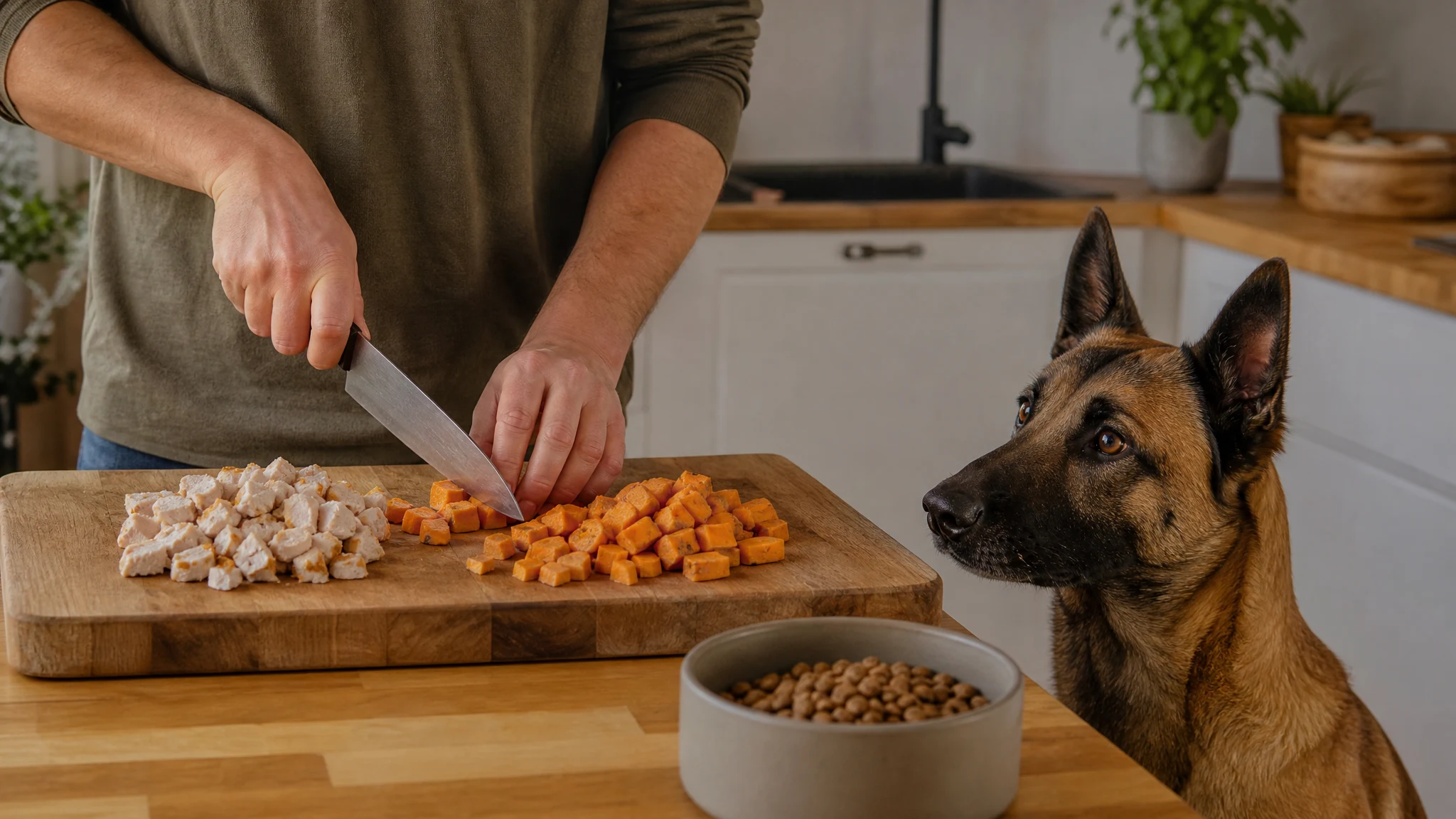
General nutrition information compiled from product labels and published sources, not veterinary advice. Your veterinarian is the right person to choose a diet for your dog, especially one with a health condition.
No bag can promise a calm stomach for a Belgian Malinois. What you can do is read the label carefully and pick a food that fits the dog in front of you. This guide shows how to do that, step by step.
We compared label data only. We did not run feeding trials or taste tests, and we are not ranking foods by how they work in any dog's gut. For a full side-by-side, see our label comparison of dog foods for Belgian Malinois.
What "gut health" can and cannot mean on a label
"Gut health" is a marketing phrase, not a label category. The best dog food for gut health in a Belgian Malinois is, in practice, a complete and balanced food that your dog digests well and that suits their age and size. Only your dog's stool, appetite and energy, plus your veterinarian's advice, can tell you that.
Hill's Pet notes that the breed can be at risk for allergies, with skin and/or gastrointestinal signs. If your dog has ongoing loose stools, vomiting or itching, that is a question for a veterinarian. A veterinarian decides whether a diet change, a test or a prescription diet is right. No over-the-counter food treats a medical problem.
Materials you need
- The food bag or can, or the brand's product page, with the full ingredient list.
- Your dog's current weight and age. Hill's lists adult Malinois at roughly 40 to 80 pounds, with males usually heavier than females.
- A kitchen scale or measuring cup.
- A notebook or phone note to track stools, appetite and weight.
- Your veterinarian's contact, in case signs do not settle.
Step 1: Match the life stage and size
Start with the nutritional adequacy statement. It is usually a sentence near the ingredient list that mentions AAFCO.
Hill's advises large-breed puppy food for this breed, so treat the Malinois as a large dog. Whole Dog Journal explains that foods for growth or all life stages must say either "including growth of large size dogs (70 lb or more as an adult)" or "except for growth of large size dogs." Many adult Malinois weigh under 70 pounds, so that wording is a guide to the food's nutrient levels, not a claim about your dog's final weight.
For puppies, Cornell University's Riney Canine Health Center says to feed a diet formulated for large breeds. It also says not to add calcium or vitamin D supplements to a growing puppy, and to avoid overfeeding or rapid growth in puppies predisposed to hip dysplasia.
Step 2: Read the first five ingredients
Ingredients are listed by weight before cooking, so the first few tell you most about the recipe. Look for:
- A clearly named protein. "Chicken" or "chicken meal" says more than a vague term.
- Named fat sources. "Chicken fat" is clearer than a generic "animal fat."
- A recognizable carbohydrate or fiber source, such as rice, barley, oats or peas.
Here is what the brands' own pages list for a few large-breed options:
| Food | First ingredients on the label | Life stage |
|---|---|---|
| Hill's Science Diet Adult Large Breed Chicken & Barley | Chicken, cracked pearled barley, brown rice, brewers rice, whole grain wheat | Adult maintenance |
| Royal Canin Large Adult | Chicken by-product meal, brewers rice, wheat, brown rice, chicken fat | Adult maintenance |
| Victor Hi-Pro Plus Large Breed Puppy | Chicken, chicken meal, brown rice, whole grain millet, whole grain sorghum | All life stages, including large-dog growth |
| Freshpet Vital Chicken Recipe with Peas, Carrots & Brown Rice | Chicken, chicken liver, peas, carrots, chicken broth | All life stages, including large-dog growth |
None of these is made for Belgian Malinois specifically, and none is a gut-health product by label. Ingredients that look good on paper still might not suit a given dog.
Step 3: Check the numbers, and know what they mean
Look at protein, fat, fiber and calories. Be careful here, because brands report them differently. Royal Canin and Victor give guaranteed-analysis style figures. Hill's gives average nutrient content on a dry matter basis, which is not a guaranteed minimum. Wet and fresh foods contain a lot of water, so their percentages look much lower. Freshpet lists a maximum moisture of 76 percent. You cannot compare a fresh roll with a dry kibble by percentages alone.
Fiber is the number people often connect with digestion. The brands above list crude fiber from about 1.5 percent (Freshpet's maximum) up to 6.0 percent (Victor's maximum). The label does not say that one number is better for the gut, so do not read more into it than that.
Calories matter too. Hill's lists 365 kcal per cup for its adult large breed dry food, Royal Canin lists 360 kcal ME per cup, and Victor lists 365 kcal per cup. Brands differ, so the same cup of two foods is not the same amount of energy.
Step 4: Look for digestive-support claims, and read them skeptically
Some labels mention probiotics, prebiotics, fermentable fibers or similar additives. The product data we compared does not include any such claims, so we cannot tell you which foods have them or whether they help. If a brand makes one, check three things:
- Is the ingredient actually named in the ingredient list or guaranteed analysis?
- Does the brand explain what it is, in plain words, on its own page?
- Does the wording stay with words like "supports" instead of promising a result?
If you cannot find clear answers, ask the brand directly and ask your veterinarian.
Step 5: Think about grain, DCM and trends
The FDA's Center for Veterinary Medicine has investigated a possible link between certain diets and canine dilated cardiomyopathy (DCM). Its latest update is dated December 23, 2022, and the FDA says it does not plan further public updates until there is meaningful new scientific information. Read the FDA page yourself and ask your veterinarian if you are weighing a grain-free or boutique-brand food. Every food in the table above is listed as not grain free except where the brand does not say.
Step 6: Set a starting amount, then adjust
Use the feeding chart or calculator on the brand's page as a starting point. Royal Canin's page, for example, shows a daily chart by weight and activity, and Hill's says to adjust amounts as necessary to maintain optimal weight and to ask a veterinarian if you are unsure.
Hill's also says excess weight adds strain on joints, and that hip and elbow dysplasia can be common in the breed, with risk rising with weight gain. It suggests keeping treats to 10 percent of daily calories. Weigh the food rather than eyeballing the scoop.
Cornell says large, deep-chested dogs are most at risk of bloat (GDV). Its tips include feeding two or more meals a day, using smaller kibble, limiting activity after meals and avoiding raised bowls. Cornell's page does not name the Malinois, and we could not confirm breed-specific risk, so ask your veterinarian how this applies to your dog.
Step 7: Switch foods slowly and keep notes
Change foods over several days by mixing a little of the new food into the old, then raising the share each day. Your veterinarian or the brand's page can suggest a schedule. Write down stool quality, appetite, energy and any itching or vomiting.
Do not change the food, the treats and the chews all at once. If you do, you will not know which change caused a problem.
Common mistakes to avoid
- Treating "gut health" as a guarantee. It is a marketing phrase, and labels cannot promise a result.
- Judging by the front of the bag. Read the ingredient list and adequacy statement instead.
- Comparing percentages across wet, fresh and dry foods. Moisture changes the numbers.
- Adding supplements to a growing puppy. Cornell advises against calcium and vitamin D supplements for growing large-breed puppies.
- Switching too fast, or switching constantly. A new food needs time before you can judge it.
- Waiting out ongoing signs. Repeated vomiting, blood in stool, a swollen belly or lethargy needs prompt veterinary care.
What results to expect
If a food suits your dog, you may see steady appetite, regular stools and a stable body weight over several weeks. Some dogs will do well on one of these foods and poorly on another. We cannot predict which, and no label can.
If stools stay loose, your dog itches a lot or the signs get worse, stop experimenting and talk to your veterinarian. Your veterinarian decides whether a medical cause or a prescription diet is involved.
Quick checklist
- Choose a food whose AAFCO statement matches your dog's age and large size.
- Check that the first ingredients are clearly named.
- Compare calories per cup or can, not just protein percentages.
- Treat probiotic or digestive claims with caution and ask the brand to explain them.
- Measure portions, and keep treats to about 10 percent of daily calories.
- Change foods slowly and track results.
- Call your veterinarian for ongoing digestive signs.
For specific foods and their label data side by side, return to our Belgian Malinois dog food comparison.
Sources
- Hill's Pet, Belgian Malinois breed page
- Cornell University Riney Canine Health Center, Gastric dilatation-volvulus (bloat)
- Cornell University Riney Canine Health Center, Canine hip dysplasia
- FDA Center for Veterinary Medicine, DCM investigation
- Whole Dog Journal, In the Fine Print: Nutritional Adequacy Statements
- Hill's Science Diet Adult Large Breed Chicken & Barley
- Royal Canin Large Adult
- Victor Hi-Pro Plus Large Breed Puppy
- Freshpet Vital Chicken Recipe with Peas, Carrots & Brown Rice